









Kannan Gopinathan’s political entry
text_fields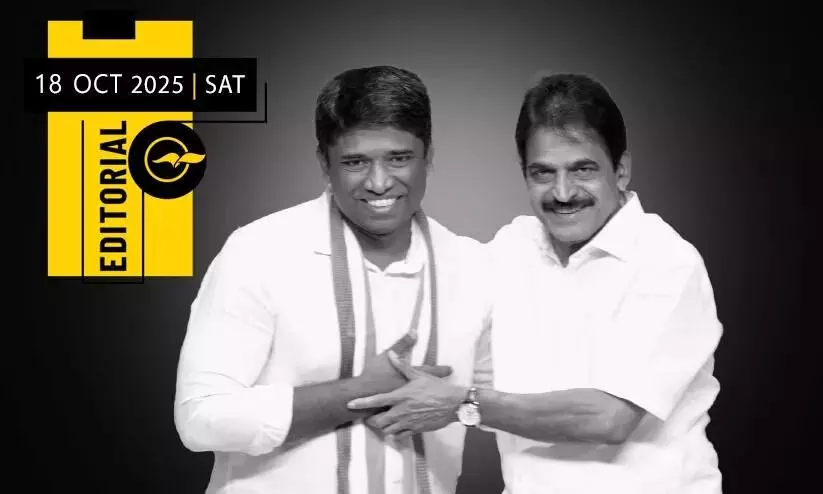

Kannan Gopinathan, a Keralite IAS officer who resigned from the civil service six years ago in protest against the anti-democratic policies of the Narendra Modi government, has joined the Indian National Congress. At a function held at the Congress headquarters in Delhi last Monday, in the presence of national leaders Pawan Khera and K.C. Venugopal, his words were as follows: "I resigned in 2019 when it became clear that the Modi government was not taking the country in the right direction. I had to fight against the wrong policies of the government. For this, I travelled to 90 districts of the country and spoke to the people and leaders. During that journey, I realised that the Congress is the only movement capable of leading the country in the right direction. From this moment, the fight against the divisive agenda of the government is beginning." These words make it clear what the purpose of Kannan Gopinathan's political entry is. Besides this, the entry of this former bureaucrat into the Congress has many dimensions in the current national politics.
Kannan Gopinathan's resignation was immediately in protest against the central government's abrogation of Article 370 of the Constitution, which granted special status to Jammu and Kashmir. Before that, he was a public servant who went beyond being a mere bureaucrat and worked for the common people. He has received both praise and criticism for that. Kannan was the collector of Dadra and Nagar Haveli. At that time, Kerala was hit by floods in 2018. After going on leave, he immediately returned home and joined the volunteers. No one paid any attention to the young man who was working at the collection centre at the KBPS (Kerala Books and Publications Society) Press in Kakkanad. He was just one among the 10,000 volunteers who had put their heart and soul into the work in the face of the disaster. He continued to work without any celebrity status until another IAS officer who came to visit the collection centre recognised him. Before returning, he also took the initiative to contribute Rs 1 crore from the funds of the MP representing Dadra and Nagar to the Chief Minister's Relief Fund. During his tenure, Kannan Gopinathan also spoke out in support of over 500 tribals who were at risk of losing the temporary jobs provided to them by the government, an act the authorities at the Centre did not relish. It was while they continued to harass him by giving him show-cause notices and other means that he took the protest to the next level by resigning from his IAS post onKashmir issue. After his resignation, what the public saw was Kannan Gopinathan at the forefront of protests against the Citizenship Amendment Act. Along with this, he also explained to the public how constitutional institutions like the Election Commission act as state instruments.
One of the biggest interventions of Kannan Gopinathan, who gave up his IAS rank, was the doubts he raised regarding the transparency of the functioning of the Electronic Voting Machine (EVM). Most of them are questions that remain unanswered even today. In a way, even the Congress leadership’s moving the Supreme Court questioning the transparency of the Election Commission’s functioning was based on the questions raised by people like Kannan Gopinathan. He alleged that even the voter does not have the opportunity to verify whether his vote was cast for the intended candidate or not, and that it is the limitation of the EVM even if it is transparent. The voter can only cast his vote by blindly trusting the machine. The VVPAT system was introduced as a solution to that. However, Gopinathan argued with evidence that it was a bigger scam than the former. His question is still relevant as the VVPAT is not connected to the control unit of the voting machine, so how can one know whether the symbol displayed on the VVPAT screen is the same as the one recorded in the control unit? This question was taken up by people like Jairam Ramesh before the Lok Sabha elections and a strong legal battle was initiated. It is in continuation of this the Vote Chori campaign emerged, putting the Election Commission under suspicion. In other words, Kannan Gopinathan has finally reached the very political party that actively took up the criticisms he had raised earlier regarding the government's actions that damaged democracy. Bureaucrats, technocrats and diplomats have all been part of the Congress before. Many of them later left the party as fortune seekers; some of those who remained have a history of putting the party on the defensive at least on some occasions. If Kannan Gopinathan can work away from all those dark historical moments, it will be a great asset to that party and the democratic society.