


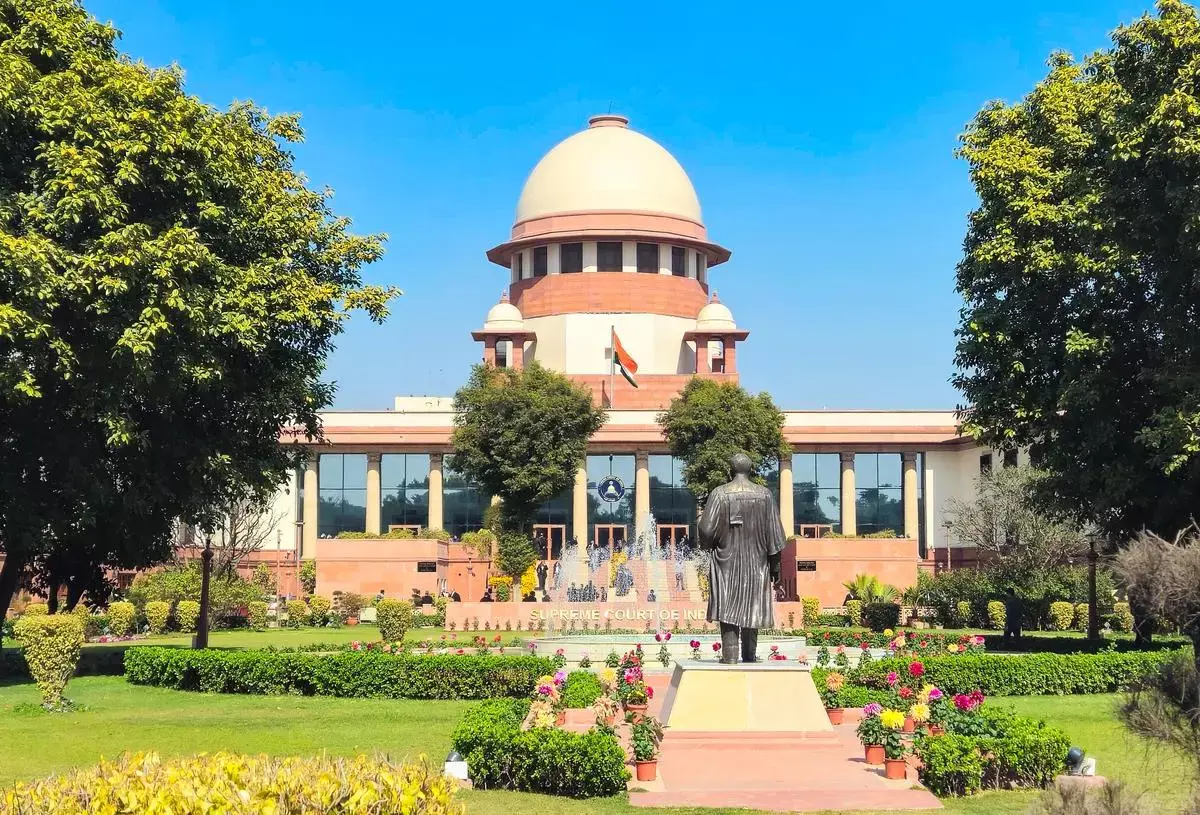













Supreme Court issues notice to Centre over Tamil Nadu’s plea on Samagra Shiksha funds
text_fields

The Supreme Court on Monday issued a notice to the Union government after the Tamil Nadu government complained about the denial of funds under the Samagra Shiksha Scheme (SSS).
The state said the refusal had created a heavy financial burden in implementing the Right to Education (RTE) Act for students from economically weaker sections in private schools.
The notice was issued by a bench of Justices Vikram Nath and Sandeep Mehta on Tamil Nadu’s appeal against a June order of the Madras High Court. On June 10, the high court had delinked reimbursements under the RTE Act from the Union government’s financial obligations to the state under the SSS.
During arguments, Additional Solicitor General A.R.L. Sundaresan told the court that SSS was aligned with the New Education Policy (NEP).
He said the scheme treated education as a continuum from pre-school to Class 12, and that it was primarily the responsibility of the state to implement the RTE Act. The Madras High Court had observed that the state government is required to reimburse private unaided schools, and that the lack of funds from the Union government cannot be used as an excuse to avoid this statutory responsibility.
Appearing for Tamil Nadu in the Supreme Court, senior advocate P. Wilson argued that the high court’s directions had imposed a financial load of more than Rs 342 crore on the state. He said the centre had failed to release Rs 342.69 crore, representing its 60% share for the academic years 2021-22 and 2022-23.
Tamil Nadu’s petition stated that the Union government has a concurrent duty under Section 7 of the RTE Act, 2009, to share responsibility for education funding. The plea said the high court erred in ruling that only the state bore responsibility for expenses and directing it to shoulder the full burden for the 2025-26 academic year.
The petition stated that Section 7 was designed to prevent states from facing a shortage of funds that could hinder the implementation of the Act, which is why both the Central and State governments were given concurrent responsibility.
It also argued that the “Central government has been propagating its political agendas through the Samagra Shiksha scheme.” The petition further argued that differences in political ideology should not prevent a State government from carrying out the provisions of the Samagra Shiksha scheme and the RTE Act. It emphasized that only through cooperation between the Central and State governments could these provisions be fully implemented, adding that the fundamental right to education should not depend on the discretion of the Central government.
Meanwhile, Congress MP from Tiruvallur, Sasikanth Senthil, ended his hunger strike on September 1. He had launched the protest on August 29 against the centre’s withholding of funds, which he said “put the future of 43 lakh students and 2.2 lakh teachers in Tamil Nadu in grave uncertainty.”
On August 31, the third day of his protest, Senthil was shifted from Tiruvallur Government Hospital to Rajiv Gandhi Government General Hospital in Chennai. He suspended the hunger strike on Monday after the INDIA alliance leaders appealed to him, considering his health condition.